
If you’re a waste producer, you’ll know that finding the right waste site isn’t as simple as typing something into Google and hoping for the best. There’s a whole process before you even reach the point of choosing a facility — and it starts with the EWC code.
Step 1: Choosing the Correct EWC Code
This is where most people get stuck — and honestly, it’s understandable.
Give the same waste to three different people and you’ll often get three different codes. Not because anyone is doing anything wrong, but because the coding system is based on how the waste was produced, not just what it looks like. The UK classification guidance is essential here.
How EWC Codes Are Structured
Each code has three parts:
- Chapter (first two digits): the industry or process the waste came from
- Sub-chapter (middle two digits): the specific activity
- Waste type (last two digits): the actual material
So before you can code anything, you need to understand how it was created.
Glass Is the Perfect Example
Glass can fall under multiple codes depending on its origin:
- Packaging glass
- Construction and demolition glass
- Glass from WEEE
- Glass fines from processing
- Glass contaminated with hazardous substances
Same material.
Different processes.
Different codes.
Mirror Entries
Then there are mirror entries — pairs of codes where the waste may be hazardous depending on contamination. These require assessment and, in many cases, testing to confirm which code applies under WM3.
Colour Coding Helps
If you’ve ever used a coloured EWC list, you’ll recognise:
- Black = Non-hazardous
- Red = Hazardous
- Blue = Mirror hazardous
- Green = Mirror non-hazardous
These colour indicators are genuinely helpful when determining what you’re dealing with and whether testing is required.
Once you’ve worked through all of that and finally settled on a code… the next challenge begins.
Step 2: Finding a Site That Can Take It
Producers typically rely on a combination of:
- Waste brokers
- Colleagues
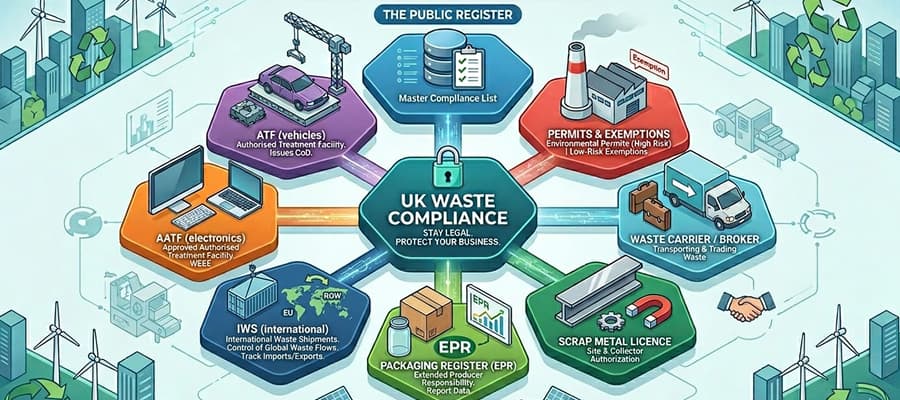
- The Public Register
- Sites they’ve used before
All of these methods can work. But they can also be time-consuming — especially when the EWC code doesn’t match the everyday description of the waste.
A few common examples:
- Vapes → coded as small mixed WEEE
- Street sweepings → 20 03 03
- Mixed loads → often need breaking down into multiple codes
- Mirror entries → require testing before a site can confirm acceptance
So even when you’ve identified the correct code, it may not resemble the waste as you know it — which makes searching even harder. A structured directory search by code and location can reduce that friction significantly.
Step 3: Making Contact
Once you’ve identified a site that might accept your waste, you still need to:
- Call the main number
- Get transferred
- Explain the waste again
- Fill out a form
- Email a general inbox
- Wait for a response
It works — but it takes time. And producers often don’t know who the right contact is or what specific information the site needs upfront. That is exactly where a single multi-site enquiry helps.
This Is Why I Built What Waste Code
Not to replace the Public Register.
Not to bypass compliance.
But to support producers and sites by making that first step easier.
Once you know your EWC code and waste description, you can search by:
- Code
- Description
- Postcode
- Site name
- Waste type
You’ll see:
- Permit details
- Accepted waste streams
- Accreditations
- ATF, scrap, battery, and other register information
- Clear descriptions explaining what the site actually handles
And instead of contacting sites one by one, you can select multiple facilities, complete one enquiry form, upload photos, and send your enquiry directly to the right person.
No general inbox.
No chasing.
No repeating yourself.
Just a smoother starting point.
Duty of Care Still Applies
What Waste Code does not remove the need for duty of care checks, including:
- Testing (where required)
- Confirming acceptance
- Checking volumes
- Checking contamination levels
- Ensuring the site is suitable
Those responsibilities remain exactly where they should be — on both sides.
What it does do is make it easier to:
- Find the right sites
- Start the right conversations
- Share the right information
- Reduce unnecessary back-and-forth
Because producers want clarity.
Sites want accurate enquiries.
And the industry works better when both sides can connect quickly and confidently.
For more practical guidance, browse the rest of our blog.